by Ad America | Aug 24, 2026 | Uncategorized
When your trucks are on the road eight, ten, twelve hours a day, they’re doing more than hauling freight — they’re advertising your business to every driver who shares the highway with them. That’s why Semi-Truck Graphics have become one of the smartest investments a fleet owner can make. From bold tractor lettering to eye-catching trailer graphics, professionally designed truck graphics turn your fleet into a rolling billboard while keeping you compliant with federal DOT regulations.
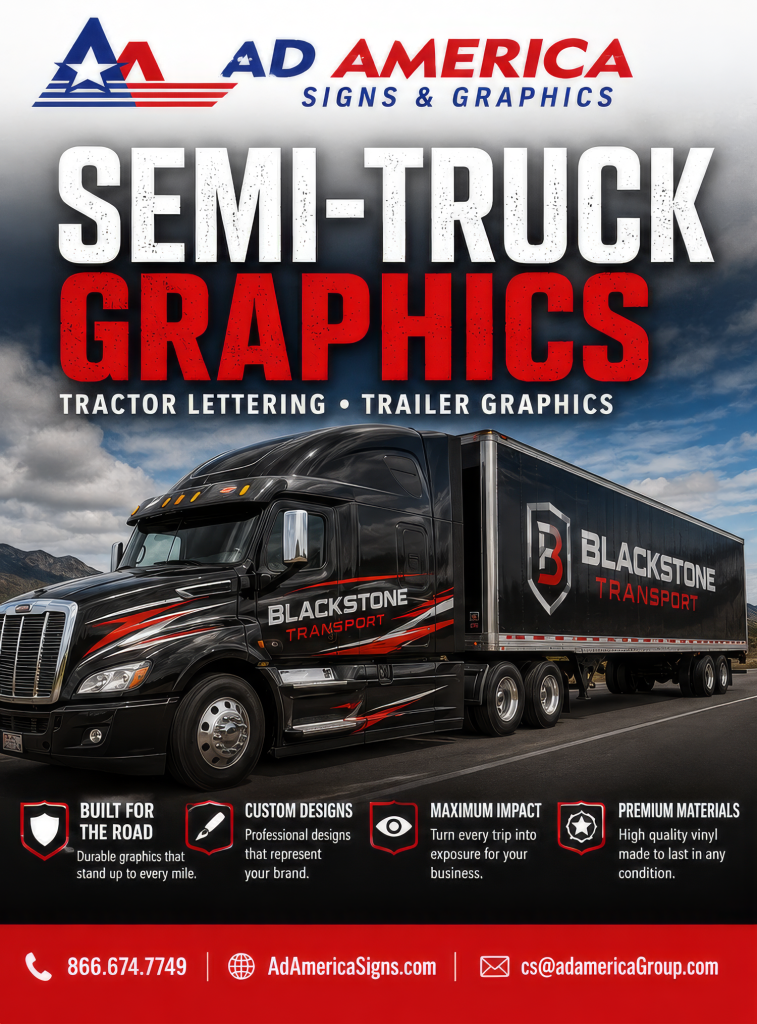 Since 1986, Ad America has been Serving Southern California with custom vehicle graphics, fleet branding, and commercial truck lettering. Whether you operate a single rig or a fleet of fifty, our team designs and installs Semi-Truck Graphics, tractor lettering, trailer graphics, DOT lettering, logos, decals, and full or partial wraps that are built to last through wind, rain, sun, and thousands of miles on the road.
Why Semi-Truck Graphics Matter for Your Business
A commercial truck without graphics is a missed opportunity. Studies on mobile advertising consistently show that vehicle graphics generate tens of thousands of impressions per day in dense metro areas — and Southern California’s freeways are some of the busiest in the country. Well-designed Semi-Truck Graphics do three things at once:
They build brand recognition every time your truck passes another vehicle, sits at a loading dock, or parks at a truck stop. They project professionalism to clients, partners, and potential customers who judge a company’s credibility partly by the condition and appearance of its fleet. And they keep you compliant, since the Federal Motor Carrier Safety Administration (FMCSA) requires specific identifying information to be lettered on the sides of commercial vehicles.
At Ad America, we treat every project as both a marketing opportunity and a compliance requirement. Our designers work with your existing brand guidelines — or help you build a brand from scratch — to create Semi-Truck Graphics that represent your company accurately on the highway.
Tractor Lettering: Where Compliance Meets Brand Identity
Tractor lettering is one of the most visible and most regulated parts of commercial vehicle branding. The tractor — the cab and engine unit that pulls the trailer — is where your company name, USDOT number, and other required information typically appear.
Our tractor lettering services include:
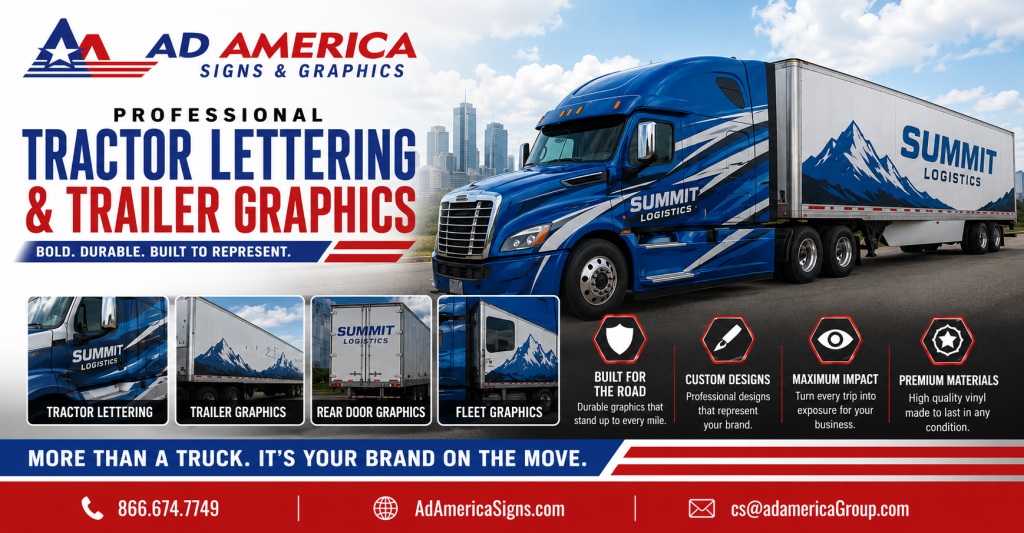
Custom door lettering with your company name, city and state, and USDOT/MC numbers in FMCSA-compliant sizing and contrast. Cab-side logos and decals that reinforce your brand every time the truck is parked or moving. Reflective and high-visibility lettering options that improve nighttime readability and safety. Durable vinyl materials rated for years of exposure to sun, road grime, and pressure washing.
Because tractor lettering has to satisfy both marketing goals and legal requirements, precision matters. Our team measures letter height, stroke width, and color contrast to make sure your tractor lettering meets DOT standards while still looking sharp and on-brand.
Trailer Graphics That Turn Heads on the Highway
If tractor lettering is about compliance and consistency, trailer graphics are where your brand really gets to shine. The trailer offers the largest, flattest, most visible canvas on your entire vehicle — and that space is valuable real estate for advertising.
Ad America designs trailer graphics ranging from simple logo placement and contact information to full-color, photo-realistic wraps that wrap around every panel. Popular trailer graphics options include:
Large-format logo and brand graphics that are visible from a distance. Contact information, website URLs, and QR codes that convert highway visibility into leads. Full trailer wraps that transform a blank box trailer into a moving advertisement. Partial wraps and striping that add color and visual interest at a lower cost than a full wrap. Reflective safety striping in compliance with DOT and FMCSA requirements for trailer visibility.
Because trailer graphics are typically viewed from a distance — by drivers on the freeway, at intersections, or in a parking lot — our design team pays close attention to readability, contrast, and composition so your message is clear even at 65 miles per hour.
DOT Lettering Requirements for Commercial Trucks
 DOT lettering isn’t optional — it’s a federal requirement for most commercial motor vehicles operating across state lines or above certain weight thresholds. Under FMCSA regulations, your truck must display:
Your legal company name or trade name. The city and state of your principal place of business. Your USDOT number, and MC number if applicable, prefixed correctly. Lettering that contrasts sharply with the vehicle’s background color and meets minimum height requirements.
Getting DOT lettering wrong can result in fines during roadside inspections, so it pays to work with a shop that understands the regulations inside and out. Ad America has been producing compliant DOT lettering for Southern California fleets for decades, and we make sure every tractor and trailer leaves our shop road-legal and ready to work.
Logos, Decals, and Fleet Branding
Beyond required lettering, logos and decals are what make your fleet instantly recognizable. A consistent logo across every tractor and trailer helps customers, dispatchers, and even other drivers identify your trucks at a glance — which matters for brand recall, safety reporting, and simple professionalism.
Our logo and decal services include full brand development for companies that don’t yet have a logo, vinyl decal production in any size or shape, fleet-wide consistency so every truck in your operation matches, and small-format decals for safety information, load capacity, or company slogans.
Whether you need a single decal or a fully branded identity system rolled out across dozens of vehicles, our design and production process keeps everything consistent from the first truck to the last.
Full and Partial Truck Wraps
For fleets that want maximum visual impact, full or partial wraps are the ultimate option. A full wrap covers the entire tractor, trailer, or both in custom-printed vinyl graphics — turning your vehicle into a moving billboard with no blank space left unused. A partial wrap covers a portion of the vehicle, combining printed graphics with the truck’s existing paint for a striking look at a more accessible price point.
Full and partial wraps are ideal for companies that want to make a bold statement, promote a new service or product line, or simply stand out from competitors on the highway. Ad America uses premium, commercial-grade vinyl and laminate designed to withstand years of highway driving, weather exposure, and regular washing — so your investment keeps looking sharp mile after mile.
Choosing the Right Materials for Long-Lasting Truck Graphics
Not all vinyl is created equal, and the material you choose has a direct impact on how long your Semi-Truck Graphics hold up under real-world conditions. Southern California’s combination of intense sun exposure, high desert heat inland, and coastal humidity near Los Angeles and Orange County means fleet graphics need to be built for a wide range of conditions.
Ad America uses commercial-grade cast and calendared vinyl films depending on the application, paired with UV-resistant laminates that protect tractor lettering and trailer graphics from fading. For curved surfaces, aerodynamic fairings, and riveted trailer panels, we select conformable films that stretch and settle into contours without bubbling or lifting. For flat trailer sides, we often recommend premium cast vinyl for full and partial wraps, since it offers the best dimensional stability over years of highway vibration and temperature swings.
We also factor in installation environment. Trailer graphics and tractor lettering applied in a controlled shop environment — rather than outdoors in variable temperatures — adhere more evenly and last significantly longer. That’s one reason fleet operators throughout Riverside, San Bernardino, and the greater Inland Empire trust Ad America’s shop-based installation process over mobile, drive-up services.
Frequently Asked Questions About Semi-Truck Graphics
How long do Semi-Truck Graphics last? With proper installation and quality materials, tractor lettering and trailer graphics typically last five to seven years, even with daily highway use and regular washing.
Is DOT lettering required on every commercial truck? Most trucks operating in interstate commerce, or above certain weight and passenger thresholds, are required to display DOT lettering, including your USDOT number, company name, and city/state of operation. Requirements can vary, so it’s worth confirming your specific obligations with Ad America before your next inspection.
What’s the difference between a full wrap and a partial wrap? A full wrap covers the entire tractor or trailer in printed vinyl, while a partial wrap covers select panels or sections, blending graphics with the vehicle’s existing paint. Partial wraps are a cost-effective way to add branding and color without the expense of a complete wrap.
Can Ad America handle a large fleet rollout? Yes. From single-truck lettering jobs to fleet-wide rebranding across dozens of tractors and trailers, our production and installation process is built to scale while keeping every vehicle consistent.
Why Choose Ad America for Semi-Truck Graphics
Ad America has been Serving Southern California Since 1986, and commercial fleet graphics have always been at the core of what we do. When you choose us for Semi-Truck Graphics, tractor lettering, trailer graphics, DOT lettering, logos, decals, or full and partial wraps, you get:
Decades of experience designing and installing compliant, durable commercial vehicle graphics. In-house design teams who understand both branding and DOT regulations. Premium materials built to handle Southern California’s sun, heat, and highway miles. A streamlined process from design proof to installation, so your trucks are back on the road fast.
You can explore more of our custom vehicle graphics and decal options on our products page, where we showcase the full range of signage, decals, and wraps we produce for fleets just like yours. For additional information on our commercial vehicle graphics capabilities, visit Ad America Signs.
Proudly Serving Fleets Throughout Southern California
Ad America proudly serves businesses throughout Upland, Ontario, Rancho Cucamonga, Pomona, Claremont, Fontana, Riverside, San Bernardino, Los Angeles County, Orange County, Riverside County, San Bernardino County, and throughout Southern California. Wherever your trucks are based, our team can design, produce, and install Semi-Truck Graphics, tractor lettering, and trailer graphics that keep your fleet compliant and looking professional.
Get Started on Your Semi-Truck Graphics Project
Your trucks are already on the road — make sure they’re working as hard for your brand as they are for your freight. From DOT-compliant tractor lettering to full trailer wraps, Ad America brings decades of Southern California experience to every Semi-Truck Graphics project we take on.
Contact Ad America today to get a free quote on Semi-Truck Graphics, tractor lettering, trailer graphics, DOT lettering, logos, decals, or full and partial wraps for your fleet.
by Ad America | Aug 14, 2026 | Schools and PBIS
Bringing School Campus Graphics Pride to Every Corner of Campus
Walk onto any well-branded school campus and you can feel the difference before a single word is spoken. The colors on the entryway sign, the mascot painted above the gym doors, the motivational quotes lining the main hallway — all of it works together to tell students, staff, and visitors exactly who this school is and what it stands for. That consistent, campus-wide identity is the goal of School Campus Graphics, and it is one of the most effective ways a school district can build pride, improve wayfinding, and create a more professional, welcoming environment for everyone who walks through the doors.
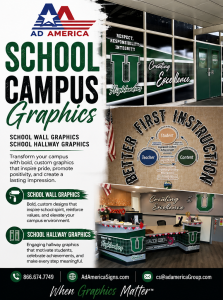 At Educated Graphics by Ad America, Serving Southern California Since 1986, we specialize in helping schools plan, design, and install School Campus Graphics that carry a district’s brand from the front entrance all the way to the back of the last classroom hallway. This article covers what School Campus Graphics really are, where they make the biggest impact, and how two of the most requested elements — School Wall Graphics and School Hallway Graphics — fit into a complete campus branding strategy.
What Are School Campus Graphics?
School Campus Graphics is a broad term that covers every piece of visual branding a school uses across its physical property. That includes exterior building signage, monument and entrance signs, gymnasium and athletic facility graphics, cafeteria displays, donor recognition walls, window graphics, directional signage, and of course School Wall Graphics and School Hallway Graphics throughout the interior of the building.
The best School Campus Graphics programs are not a collection of unrelated projects added over the years. They are planned as one cohesive system, using the same color palette, fonts, logo files, and design language everywhere they appear. When a visitor sees the same mascot, the same shade of school blue, and the same typography on the entrance sign, the gymnasium wall, and the hallway banners, the campus feels intentional, unified, and proud of its identity.
Where School Campus Graphics Make the Biggest Impact
Every school campus has a handful of spaces where graphics do the most work in shaping how the school is perceived.
Entryways and front offices are the first impression for parents, prospective families, and visitors. Bold School Campus Graphics here — logos, mission statements, and welcome messaging — set the tone immediately.
Gymnasiums and athletic facilities are natural gathering spaces for students, families, and the surrounding community, which makes them one of the highest-impact locations for large-scale mascot graphics, championship banners, and school-color accent walls.
Cafeterias and common areas benefit from graphics that reinforce school spirit during the times of day when the largest number of students are gathered in one place.
Hallways and stairwells carry students from class to class dozens of times a day, making them an ideal location for motivational messaging, wayfinding graphics, and class-of banners.
Exterior walls and fencing along the perimeter of campus are often overlooked, but they offer excellent visibility to the surrounding neighborhood and reinforce the school’s identity to the community every single day.
School Wall Graphics: Making Every Wall Work Harder
School Wall Graphics are one of the most versatile tools in a School Campus Graphics program because nearly every school has large, blank wall space that can be transformed into something meaningful. Instead of leaving hallway, gymnasium, or cafeteria walls plain, districts are increasingly using large-format vinyl graphics, dimensional lettering, and full mural-style installations to fill that space with purpose.
Popular applications for School Wall Graphics include mascot murals in gymnasiums, mission and vision statements in front offices, donor and legacy recognition walls, school history timelines, and school-colors accent walls behind reception desks or in main hallways. Because wall graphics are typically installed using durable, removable, or repositionable materials, schools can update or refresh them as mascots, leadership, or branding evolve over time without damaging the underlying wall surface.
Well-designed School Wall Graphics also do double duty as a teaching tool. Many schools use wall graphics to display core values, academic expectations, or historical milestones, turning hallway and classroom walls into a passive but constant reminder of what the school community stands for.
School Hallway Graphics: Wayfinding Meets School Spirit
If School Wall Graphics set the tone in key gathering spaces, School Hallway Graphics keep that same energy moving throughout the rest of the building. Hallways are where students spend a surprising amount of their day, walking between classes, lockers, and shared spaces, which makes hallway graphics one of the highest-visibility, highest-frequency touchpoints on any campus.
School Hallway Graphics commonly include directional and wayfinding signage that helps students and visitors navigate large or multi-building campuses, motivational quotes and inspirational messaging placed at eye level along main corridors, class-of banners and graduate recognition displays, locker bay accents in school colors, and window clings or film for hallway-facing offices and classrooms.
Because hallways see heavy daily foot traffic, School Hallway Graphics need to be installed with durable materials that can handle contact, cleaning, and years of wear without peeling or fading — another reason schools benefit from working with an experienced graphics provider rather than attempting a do-it-yourself installation.
Why Professional School Campus Graphics Are Worth the Investment
Some districts hesitate to invest in campus-wide graphics, assuming it is a purely cosmetic upgrade. In practice, School Campus Graphics deliver measurable benefits well beyond appearance.
School pride and culture. Students who see their mascot, colors, and values reflected throughout the building develop a stronger sense of belonging and pride in their school.
Improved wayfinding and safety. Clear, consistent School Campus Graphics — especially in hallways and near entryways — help students, staff, and visitors navigate campus more efficiently, which matters even more during events, open houses, and emergencies.
A stronger first impression. Prospective families touring a campus form opinions quickly. A cohesive, well-maintained School Campus Graphics program signals that the school is organized, well-funded, and proud of its identity.
Long-term value. Quality materials and professional installation mean School Wall Graphics and School Hallway Graphics hold up for years, making the investment more cost-effective than repeated do-it-yourself fixes or outdated paint jobs.
Design and Material Considerations for School Campus Graphics
Not every material is built for a school environment, so design decisions matter just as much as the creative concept. A few things we always evaluate with a district before installing School Campus Graphics include the surface type and texture, since gymnasium walls, cinder block, glass, and painted drywall all require different vinyl or print materials to adhere properly and last. Traffic level also matters, because hallways and stairwells see far more contact and cleaning than a quiet office wall, so those areas need more durable, scuff-resistant materials. Lighting conditions affect color and finish choices, since natural light in an entryway will show colors differently than fluorescent lighting in an interior hallway. Finally, future flexibility is worth planning for, since removable or repositionable materials allow schools to update mascots, achievements, or messaging without damaging walls underneath.
Why Schools Across Southern California Choose Educated Graphics by Ad America
Educated Graphics by Ad America has been Serving Southern California Since 1986, and school districts, private schools, and universities throughout the region trust us to design and install their School Campus Graphics from start to finish. Our team works directly with facilities managers, administrators, and communications staff to plan projects around the school calendar, minimizing disruption during the school year.
From large-format School Wall Graphics in gymnasiums and front offices to wayfinding-focused School Hallway Graphics in busy corridors, we handle every stage of the process — design, proofing, printing, and professional installation — using materials built to hold up under the demands of daily school life.
You can see more examples of our work in our gallery at AdAmericaSigns.com, and learn more about our full range of school branding services at Educated Graphics.
Always here to help, https://mrgrphx.com/about/contact-us/
Proudly Serving Schools Throughout Southern California
Ad America proudly serves businesses and schools throughout:
- Upland
- Ontario
- Rancho Cucamonga
- Pomona
- Claremont
- Fontana
- Riverside
- San Bernardino
- Los Angeles County
- Orange County
- Riverside County
- San Bernardino County
- Throughout Southern California
If your school is ready to unify its identity with a complete School Campus Graphics program, including School Wall Graphics and School Hallway Graphics designed to match, Educated Graphics by Ad America is ready to help. With nearly four decades of experience Serving Southern California Since 1986, we know how to design School Campus Graphics that build pride, improve wayfinding, and represent your school with a professional, cohesive look from the front entrance to the last classroom hallway.
Ready to get started? Contact Educated Graphics by Ad America today to schedule a campus walkthrough and start planning your School Campus Graphics project.
by Ad America | Aug 11, 2026 | Fleet Graphics
Why Southern California Companies Need Professional Vehicle Wraps for Landscaping and Tree
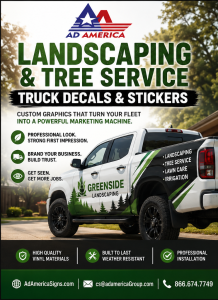 If you run a Landscaping and Tree Service company in Southern California, your trucks, trailers, and chippers are on the road every single day — parked in front of client homes, idling at job sites, and driving through neighborhoods where your next customer lives. Every one of those miles is free advertising, but only if your fleet actually looks like it belongs to a professional operation. That’s where fleet vehicle graphics come in. At Ad America, we’ve spent decades helping Landscaping and Tree Service businesses turn their work trucks, trailers, and equipment haulers into powerful, moving billboards that generate calls long after the crew has packed up and gone home.
Ad America has been Serving Southern California Since 1986, and in that time we’ve learned exactly what makes a landscaping or tree service fleet stand out on busy streets, in residential driveways, and at commercial properties. This article walks through why fleet graphics matter, which vehicles benefit most, what design elements work best, and how to get started.
Landscaping and Tree Service work is visual by nature — you’re transforming yards, removing hazardous trees, and shaping outdoor spaces that neighbors and passersby notice immediately. Yet many companies still send unmarked pickup trucks, flatbeds, and wood chip trailers out into the field, missing an obvious branding opportunity. A single branded truck can generate thousands of impressions per day simply by being parked at a job site or stuck in traffic on the 10, 60, or 91 freeways.
Professional vehicle graphics do more than look good. They build instant credibility. Homeowners and property managers are far more comfortable hiring a Landscaping and Tree Service crew that arrives in a clearly marked, professionally wrapped truck than one that shows up in an unmarked vehicle. Graphics signal that a business is established, insured, and serious about its reputation — which matters enormously in an industry built on trust, since customers are handing over access to their property and, often, their trees.
Making a Strong First Impression On the Road
First impressions happen fast. A homeowner glancing out their window, a business owner driving past a commercial job site, or a neighbor watching a tree removal crew at work — all of them form an opinion about your company within seconds. Clean, professional fleet graphics turn that split-second glance into a memorable brand impression. Bold logos, clear phone numbers, and a simple tagline can be the difference between a passerby forgetting your truck entirely and that same person saving your number for when their own tree needs trimming.
This is especially true for Landscaping and Tree Service companies working in residential neighborhoods throughout Upland, Ontario, Rancho Cucamonga, Pomona, Claremont, and Fontana, where word-of-mouth and visible reputation travel quickly from one block to the next.
Types of Vehicle Graphics for Landscaping and Tree Service Fleets
Not every vehicle in a fleet needs the same treatment, and part of what makes fleet branding effective is matching the graphic style to the vehicle’s job. Common options include:
Full vehicle wraps — a complete, edge-to-edge wrap that turns a pickup truck, box truck, or chipper truck into a rolling advertisement. Full wraps offer the most visual impact and the most creative freedom for showcasing before-and-after landscaping photos or bold tree service branding.
Partial wraps — covering key panels like the hood, tailgate, and side doors while leaving some of the factory paint visible. Partial wraps are a cost-effective way to add strong branding without wrapping the entire vehicle.
Cut vinyl decals and lettering — ideal for company names, phone numbers, license/certification numbers, and website URLs on truck doors and rear windows. This is often the entry point for smaller Landscaping and Tree Service operations building out their first branded fleet.
Magnetic signs — removable and budget-friendly, useful for owner-operators who alternate between a personal and work vehicle.
Trailer and equipment graphics — wood chip trailers, stump grinder trailers, and equipment haulers spend just as much time parked in driveways and at curbside job sites as trucks do, making them valuable (and often overlooked) branding real estate.
Design Elements That Work Best for Landscaping and Tree Service Vehicles
Effective Landscaping and Tree Service fleet graphics share a few common traits. Legibility comes first — your business name and phone number should be readable at a glance from across a residential street, which means large, high-contrast lettering rather than small or overly stylized fonts. Color palettes that reflect the industry (greens, browns, and earth tones) tend to resonate with homeowners, while a bold accent color can help a truck stand out in a sea of green pickups.
Including service highlights directly on the vehicle — tree trimming, stump grinding, hardscaping, irrigation, lawn care, or emergency storm cleanup — helps potential customers immediately understand the full range of services offered, rather than assuming a truck only handles one type of job. Licensing, insurance, and certification badges (such as ISA Certified Arborist marks) also build trust at a glance, which is especially important for tree removal work involving heavy equipment near homes and power lines.
Fleet Vehicles That Benefit Most From Graphics
Almost every vehicle in a Landscaping and Tree Service fleet can be branded, but a few tend to deliver the best return:
Pickup trucks and crew cabs are the most visible and most frequently parked vehicles at residential job sites, making them the highest-priority vehicles to wrap. Chipper trucks and bucket trucks are large, slow-moving, and highly visible on the road, turning routine tree removal jobs into extended branding opportunities. Wood chip and equipment trailers spend hours parked curbside during a job, often for longer stretches than the truck itself. Box trucks and flatbeds used for hauling mulch, soil, pavers, or equipment offer large flat surfaces ideal for full wraps. Even smaller support vehicles, like supervisor trucks or estimator vehicles, benefit from consistent branding so every vehicle representing the company looks unified and professional.
Durability and Maintenance for Work Trucks
Landscaping and Tree Service vehicles take a beating — branches, wood chips, mud, irrigation equipment, and long hours in direct sun all put wear and tear on a vehicle’s exterior. That’s why material quality matters as much as design. High-quality cast vinyl wraps and laminates are built to withstand UV exposure, abrasion, and frequent washing, keeping graphics looking sharp for years rather than fading or peeling after a single Southern California summer. Choosing an experienced installer also matters, since a properly applied wrap resists lifting at panel edges and around mirrors, door handles, and wheel wells — the areas that see the most contact during a typical workday.
The ROI of Branded Fleet Vehicles
Fleet graphics are one of the most cost-effective forms of advertising available to a Landscaping and Tree Service business. Unlike a digital ad that disappears the moment someone closes a browser tab, a wrapped truck keeps working every time it’s driven or parked — at job sites, in company lots, at the hardware store, and in daily commutes. Many business owners find that a single new customer generated by a wrapped vehicle can offset a significant portion of the wrap’s cost, with every job after that contributing directly to return on investment. Over the lifespan of a wrap, which can run several years with proper care, the cost per impression is dramatically lower than most other advertising channels.
Local Trust Across Southern California
Landscaping and Tree Service businesses depend heavily on local reputation, referrals, and repeat business from homeowners associations, property managers, and commercial clients. Ad America proudly serves businesses throughout Upland, Ontario, Rancho Cucamonga, Pomona, Claremont, Fontana, Riverside, San Bernardino, Los Angeles County, Orange County, Riverside County, San Bernardino County, and throughout Southern California. Wherever your crews are working, professionally branded vehicles help reinforce the same message every homeowner and neighbor sees: your company is established, trustworthy, and ready for the next job.
Why Choose Ad America
Ad America has been Serving Southern California Since 1986, giving us decades of experience helping Landscaping and Tree Service companies, contractors, and fleet operators design and install graphics that hold up to real working conditions. We understand the practical realities of branding a fleet that handles mulch, branches, mud, and heavy equipment every day, and we design accordingly — combining durable materials with designs that are legible, professional, and built to represent your brand well after installation day. For more background on the full range of vehicle graphics and sign solutions available, you can also explore resources at AdAmericaSigns.com.
Getting Started With Your Fleet Graphics Project
If your Landscaping and Tree Service fleet is still running unbranded, or your current graphics are faded, outdated, or inconsistent across vehicles, now is a good time to reassess. A cohesive, professionally designed fleet wrap program strengthens brand recognition, builds trust with homeowners and commercial clients, and turns every truck and trailer into a source of new leads. To see examples of the type of vehicle graphics, wraps, and signage products available for fleets like yours, browse our full product lineup.
Whether you need a single truck lettered or a full fleet of chipper trucks, trailers, and support vehicles wrapped to match, Ad America is ready to help your Landscaping and Tree Service business make the strongest possible impression on every street you work. Reach out today to start planning graphics that work as hard as your crew does.
by Ad America | Aug 9, 2026 | Uncategorized
Every year, thousands of families across Southern California gear up for another AYSO season, and with it comes the familiar rush of team meetings, practice schedules, and the search for the perfect way to show team spirit. Whether you’re a soccer parent volunteering for snack duty, a coach trying to build camaraderie, or an AYSO admin planning opening ceremonies, one thing is certain: a great AYSO season deserves great gear. From custom banners and flags that mark your team’s territory on game day to trophies that celebrate every player’s hard work, the right products turn a good season into an unforgettable one.
At Ad America, we’ve spent decades helping youth sports organizations across the region look and feel like a real team. In this guide, we’ll walk through everything parents, coaches, and AYSO admins need to know about outfitting a squad for the season ahead, and why so many Southern California AYSO regions turn to us year after year.
What Makes an AYSO Season Special for Parents and Coaches
 An AYSO season is more than just a schedule of games. It’s built on the organization’s “Everyone Plays” philosophy, balanced teams, and a genuine focus on fun over win-at-all-costs competition. For parents, that means an AYSO season is often a child’s first real introduction to teamwork, discipline, and friendly competition. For coaches, most of whom are volunteers, it means juggling practice plans with the logistics of uniforms, equipment, and morale-boosting extras that make Saturday mornings feel special.
That’s where team gear comes in. A well-branded team doesn’t just look sharp on the sideline, it builds identity. Kids remember the season they had matching banners and flags at every game. Parents remember the trophy their child proudly displayed on a bedroom shelf. And coaches remember how much easier it was to rally a team of six-year-olds when there was a giant banner with their names on it waiting at the field.
Why Custom Banners Are a Game-Changer for Your AYSO Season
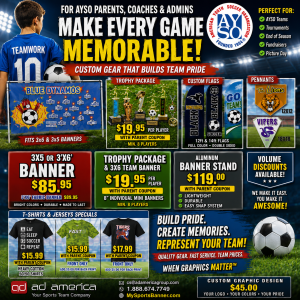
If there’s one product that instantly transforms a youth soccer sideline, it’s a custom team banner. A 3’x6′ sports team banner staked into the ground next to your bench does more than mark your spot on a crowded Saturday morning field, it becomes the backdrop for team photos, a rallying point for players before kickoff, and a lasting keepsake for families once the season wraps up.
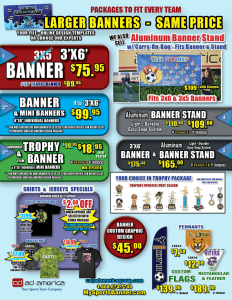
At Ad America, our most popular option is the classic Sport Team Banner, available with the team name, sponsor logos, mascot, and player names printed in vivid, weather-resistant color. For teams that want something extra memorable, we also offer banners bundled with individual mini banners for each player, a small keepsake that kids can take home and display long after the final whistle. Pair any banner with an aluminum stand and carrying bag, and your team has a professional, reusable setup that will last for AYSO season after AYSO season.
Coaches and team parents love banners because they solve a real problem: how do you make thirty different six-and-seven-year-old soccer teams look distinct and organized across a packed regional park on a Saturday? A banner answers that question at a glance, and it gives players a sense of pride that starts before the first pass is even kicked.
Flags: Small Details That Make a Big Difference
Flags might seem like a small addition to your AYSO season checklist, but they carry outsized impact. Field flags help mark boundaries and team zones at busy regional complexes where multiple games run simultaneously. Team flags, meanwhile, give coaches an easy way to signal their bench location to parents and players arriving mid-morning with equipment bags and folding chairs in tow.
Custom soccer flags from Ad America can be printed with your team colors, mascot, or AYSO region logo, giving your sideline a cohesive, professional look that matches your banner and uniforms. Many coaches use flags alongside banners to create a fully branded team area, an easy way to help younger players find “home base” between drills and water breaks. For AYSO admins coordinating opening ceremonies or tournament days, flags are also a simple, cost-effective way to mark each region or division across a large field complex.
Trophies That Celebrate Every Player
Nothing captures the spirit of an AYSO season quite like the end-of-season trophy ceremony. In keeping with AYSO’s “Everyone Plays” philosophy, most regions recognize every player, not just the top scorers, which means coaches and team parents often need trophies in bulk, on a budget, and on a tight timeline before the final game.
Ad America offers a wide range of soccer trophies and award packages designed specifically for youth leagues, from classic column trophies with soccer-ball toppers to modern medal designs that kids love to wear around their necks on picture day. We also offer bundled packages that pair a personalized trophy with a mini banner, giving families a complete, affordable keepsake of the season. Because we work with so many Southern California AYSO regions, we understand the ordering timelines coaches are up against and can help teams get their trophies ready well before the last whistle blows.
Whether your team finished first in its division or simply showed up every Saturday with a smile, a trophy in hand turns the end of the AYSO season into a celebration every player remembers.
Don’t Forget Practice Jerseys and T-Shirts
While banners, flags, and trophies get much of the spotlight, practice jerseys and custom t-shirts are the everyday workhorses of any AYSO season. A matching set of practice jerseys helps coaches run scrimmages and drills more efficiently (no more guessing who’s on which side), while custom team t-shirts give players something fun to wear to school, siblings’ games, or the team pizza party after the season wraps.
Ad America can produce practice jerseys and t-shirts in your team’s colors, complete with player names and numbers, so every child feels like part of something bigger than a single Saturday morning game. Ordering jerseys, banners, flags, and trophies together also means one point of contact, one delivery timeline, and one less thing on a volunteer coach’s already full plate.
Why AYSO Admins Trust Ad America
Coordinating dozens of teams across a single AYSO region is no small task, and admins need vendors who understand the pace and structure of a youth sports season. From bulk trophy orders to coordinated banner designs across every division, AYSO admins across Southern California rely on Ad America because we:
- Understand AYSO’s structure, from divisions and regions to the “Everyone Plays” recognition model
- Offer bundled packages (banners, mini banners, and trophies) that simplify ordering for large groups of teams
- Provide free design proofs so admins and coaches can approve artwork before printing
- Deliver consistent, on-time production so every team is ready by opening day
- Serve as a single vendor for banners, flags, trophies, jerseys, and t-shirts, saving admins the hassle of managing multiple suppliers
For regions juggling hundreds of players across multiple divisions, having one reliable partner for every AYSO season makes a measurable difference in how smoothly the season runs.
Serving Southern California Since 1986
Ad America has proudly served businesses and youth sports organizations throughout Southern California since 1986. Over the decades, we’ve built lasting relationships with AYSO regions, Little League programs, and school sports boosters throughout the area, helping outfit teams with the banners, flags, trophies, and apparel that make every season memorable.
We’re proud to serve teams and organizations throughout:
- Upland
- Ontario
- Rancho Cucamonga
- Pomona
- Claremont
- Fontana
- Riverside
- San Bernardino
- Los Angeles County
- Orange County
- Riverside County
- San Bernardino County
- Throughout Southern California
No matter which region you coach or coordinate for, our team is close by and ready to help you prepare for the upcoming AYSO season.
How to Order Your AYSO Season Gear
Getting your team ready for the season doesn’t need to be complicated. Browse our full lineup of soccer banners, flags, and trophies to see current designs, bundle options, and pricing for teams of every size. Our design team can work directly from your AYSO region’s colors and logo, or help you create something entirely custom for your squad.
For organizations looking for additional branded signage beyond the soccer field, such as event banners, vehicle graphics for team sponsors, or large-format printing for tournaments, our sister company Ad America Signs offers complementary sign and graphics services across the same Southern California service area.
Frequently Asked Questions About AYSO Season Gear
How far in advance should we order banners and trophies for AYSO season? We recommend ordering at least three to four weeks before your season or ceremony date, especially for bulk trophy orders or custom banner designs, to allow time for proofing and production.
Can AYSO admins order for multiple teams at once? Yes. We regularly work with AYSO admins to coordinate bulk orders across an entire region, including matching banner designs, bundled trophy packages, and region-wide flag orders.
Do you offer design help if our team doesn’t have artwork yet? Absolutely. Our design studio can create a custom look from scratch, including mascots, color schemes, and sponsor logos, so your team’s banners, flags, and trophies all match.
What other products can we order alongside banners and trophies? Many teams pair their banner and trophy order with practice jerseys, custom t-shirts, and pole pockets or stands for easy setup at every game.
Ready for the Next AYSO Season
Every AYSO season brings new teams, new faces, and new chances to build lasting memories on the soccer field. With the right banners, flags, trophies, and apparel, coaches and parents can spend less time worrying about logistics and more time cheering from the sideline. Explore Ad America’s full selection of soccer team banners, flags, and trophies today, and let us help make this AYSO season the best one yet for your team.
by Ad America | Aug 9, 2026 | Fleet Graphics
Truck Decals and Fleet Graphics Built for the Big Rigs
Why Fleet Vehicles, Diesel Trucks, and Semis Need Truck Decals and Fleet Stickers That Work as Hard as They Do
Your fleet is already on the road more than any billboard you could rent. Truck Decals turn every mile into marketing. Since 1986, Ad America has produced Truck Decals, Fleet Stickers, and Fleet Graphics for fleet vehicles, diesel trucks, and semis across Southern California.
A fleet vehicle spends more hours in front of potential customers than almost any other marketing asset a company owns. Delivery vans, box trucks, diesel pickups, and semis rack up thousands of miles a month, passing through neighborhoods, freeways, and job sites a print ad or social post never reaches. The only question is whether that fleet is actually advertising, or just driving around blank. That’s how a fleet stops being invisible. At Ad America, we’ve built vehicle graphics for companies running everything from single service trucks to full semi-truck fleets. Since 1986, we’ve worked with fleet managers, owner-operators, and trucking companies across Southern California who needed graphics durable enough for daily use and clear enough to do real marketing work at highway speed. Because when Graphics Matter™, a fleet vehicle becomes a rolling advertisement instead of just a way to get from one job to the next.
A Fleet That Advertises Every Mile It Drives
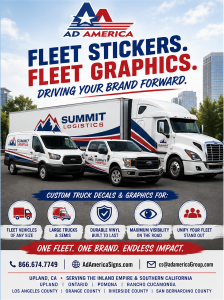 Fleet graphics get noticed more than most businesses realize. According to 3M’s research on fleet graphics, wrapped and decaled vehicles generate tens of thousands of impressions per day, and a 2019 Nielsen survey found that 64% of people had noticed a vehicle wrap or fleet graphic in the past month — outperforming traditional transit ads and poster billboards. That’s what makes this kind of marketing different from most advertising spend: a delivery van parked outside a job site, a semi pulling into a truck stop, or a box truck idling at a loading dock is doing marketing work whether the driver is thinking about it or not. Unlike a digital ad campaign that goes quiet the moment the budget runs out, Truck Decals and Fleet Graphics keep working every day the vehicle is on the road, for years at a time.
Truck Decals and Fleet Graphics for Semis and Diesel Trucks
Large trucks present a different design problem than a car or small van. A semi has a tractor and a trailer that may not even stay paired together, long flat surfaces that need graphics sized correctly to read at a distance, and mud flaps, fuel tanks, and stacks that break up where decals can go. Diesel trucks run harder miles, sit through more weather, and get washed less gently than a passenger vehicle, so this kind of graphic needs to hold up to road grime, UV exposure, and pressure washing without lifting, fading, or cracking. At Ad America, we design Fleet Graphics specifically around how a semi or diesel truck is actually built and driven — readable at highway speed, positioned around service points and access panels, and installed with materials rated for years of outdoor use. Whether it’s a single day cab, a sleeper-cab long-haul truck, a dump truck, or a full trailer, the graphics should be sized and placed for the vehicle in front of us, not a generic template.
What Federal Law Requires on Commercial Trucks
For fleet vehicles over a certain size, Truck Decals aren’t only a branding choice — some of them are required by law. Under 49 CFR 390.21, commercial motor vehicles must display the motor carrier’s legal or trade name and its USDOT number, in lettering that contrasts sharply with the vehicle’s background color and stays legible from 50 feet away during daylight. For trailers 80 inches or wider with a gross vehicle weight rating over 10,000 pounds, 49 CFR 393.11 requires retroreflective sheeting or reflectors — the familiar red-and-white striping along the sides and rear — so the vehicle stays visible to other drivers at night. Fleet managers and owner-operators are responsible for keeping that marking accurate, legible, and properly placed, which means this kind of vehicle graphic has to satisfy DOT compliance and brand consistency at the same time. Ad America builds both into the same design, so the required USDOT numbers, company name, and reflective markings work with your graphics instead of looking like an afterthought stuck on somewhere convenient.
Fleet Stickers Keep Every Truck On-Brand
A single truck with great graphics is a good start. A fleet where every vehicle matches is what actually builds recognition. Fleet Stickers — logos, phone numbers, service lists, DOT numbers, and smaller call-out graphics — need to be consistent across every truck in the fleet, whether that’s three box trucks or thirty semis. When one truck’s lettering is a different size than the one parked next to it, or the DOT number is a different font on every trailer, it reads as sloppy even if the work itself is fine. Ad America builds that consistency as a repeatable system: the same templates, materials, and placement rules applied to every vehicle that joins the fleet, so a truck added next year still matches the one that’s been on the road since 1986. You can browse our full product lineup to see the range of what’s possible on a single vehicle or across an entire fleet.
Materials Built for Life on the Road
Diesel trucks and semis don’t get the easy life a passenger car gets. They sit in direct sun for hours, get hit with road salt and debris, and go through commercial washes that are harder on vinyl than a garden hose. This kind of use needs premium cast vinyl, UV-rated laminate, and professional installation — the difference between a decal that still looks sharp in year three and one that’s peeling at the edges by month six. At Ad America, every Fleet Graphics project starts with matching the material to how the vehicle is actually going to be used: short-haul city trucks, long-haul semis, refrigerated trailers, and yard equipment all wear differently, and the right vinyl and adhesive system for one isn’t always right for another.
Every project at Ad America includes professional installation, not just printed vinyl handed over for someone else to apply. Proper installation matters as much as the material itself — a decal applied with air bubbles, misaligned seams, or the wrong surface prep will fail early no matter how good the vinyl is. Our installers work directly with fleet managers to schedule vehicles with minimal downtime, whether that means one truck at a time or a full fleet rotated through over a few weeks.
Truck Decals vs. Full Fleet Wraps — Choosing the Right Fit
Not every fleet vehicle needs a full wrap, and not every truck should stop at a logo and a phone number. Truck Decals make sense for fleets that need consistent branding without the cost of wrapping every panel — a company name, DOT markings, a service list, and a logo applied cleanly to doors and rear panels. Full Fleet Graphics wraps make more sense when a vehicle is the primary sales tool, like a company’s lead truck at trade shows or a highly visible delivery fleet in a competitive market. For semis specifically, many fleets land somewhere in between: full graphics on the tractor doors and rear of the trailer, with smaller decals covering the required DOT information and call-outs everywhere else. Ad America walks fleet managers through that decision based on budget, how the vehicle is used, and how much of the surface actually needs to carry a message — there’s no reason to pay for a full wrap on a yard truck that never leaves the lot, and no reason to under-brand a truck that’s on the highway every day.
The Return on Investment for Fleet Graphics
Compared to a monthly ad budget, Fleet Graphics are close to a one-time cost that keeps paying off for years. A semi running regional routes can rack up tens of thousands of highway miles a year, and every one of those miles puts your brand in front of new drivers who’ve never seen the company name before. Add in loading docks, truck stops, and job sites, and a well-marked fleet is generating impressions a print or digital campaign simply can’t match at the same cost. For fleet managers weighing where to spend a limited marketing budget, this is one of the few line items that keeps working long after the invoice is paid.
Serving Southern California Since 1986
Ad America has produced vehicle graphics for fleet vehicles, diesel trucks, and semis across Southern California since 1986. We proudly serve businesses throughout:
- Upland
- Ontario
- Rancho Cucamonga
- Pomona
- Claremont
- Fontana
- Riverside
- San Bernardino
- Los Angeles County
- Orange County
- Riverside County
- San Bernardino County
- Throughout Southern California
Four decades of doing this means we understand what a fleet manager actually needs — DOT-compliant marking, durable materials, and a design system that scales from one truck to a hundred.
Ready to Get Your Fleet on the Road?
If you manage a fleet of delivery vans, diesel trucks, or semis and need Truck Decals, Fleet Stickers, or full Fleet Graphics that are built to last, Ad America is ready to help. Call 866.674.7749, email cs@adamericaGroup.com, or visit AdAmericaSigns.com to start a design consultation. Ready to see what’s possible on your trucks? Shop our full product line to get started.
When Graphics Matter™, trust the company that’s been serving fleets across Southern California since 1986.
Ad America — Vehicle Graphics for Fleets & Semis Since 1986
AdAmericaSigns.com | cs@adamericaGroup.com | 866.674.7749